


 EN
EN  NL
NL 
The question everyone in marketing is asking: will AI eventually take over my job? And specifically when it comes to neuromarketing and predictive research - can we soon just unleash an LLM model on our campaigns and packaging, and call it a day?
The short answer: no, I don't think so. And it's never going to happen either. Sounds definitive. But I have good reasons for that. Let's dive into why AI - however smart - misses the context that makes your brand unique in the brain.
The Football Experiment: AI vs. Real Eyes
I want to start with a simple experiment. Imagine: you're watching a football match. Just a regular match. Nothing special. Where do you focus?
If you say "the ball", you're right. Makes sense, doesn't it? Within the context of football, that ball is essential. You want to know where the ball is, where it's going, who has it. People know this intuitively.
We tested this with eye-tracking. We had thirty people watch a match, and we tracked exactly where their eyes went. The result? A clear red dot on the ball. Everyone was looking at the ball.
Now comes the interesting part. We also had a predictive AI model watch the same match. A model trained on piles of eye-tracking data, so you'd expect it to know where people look. What do you think the model predicted?
People. The model said: everyone is looking at all the players.
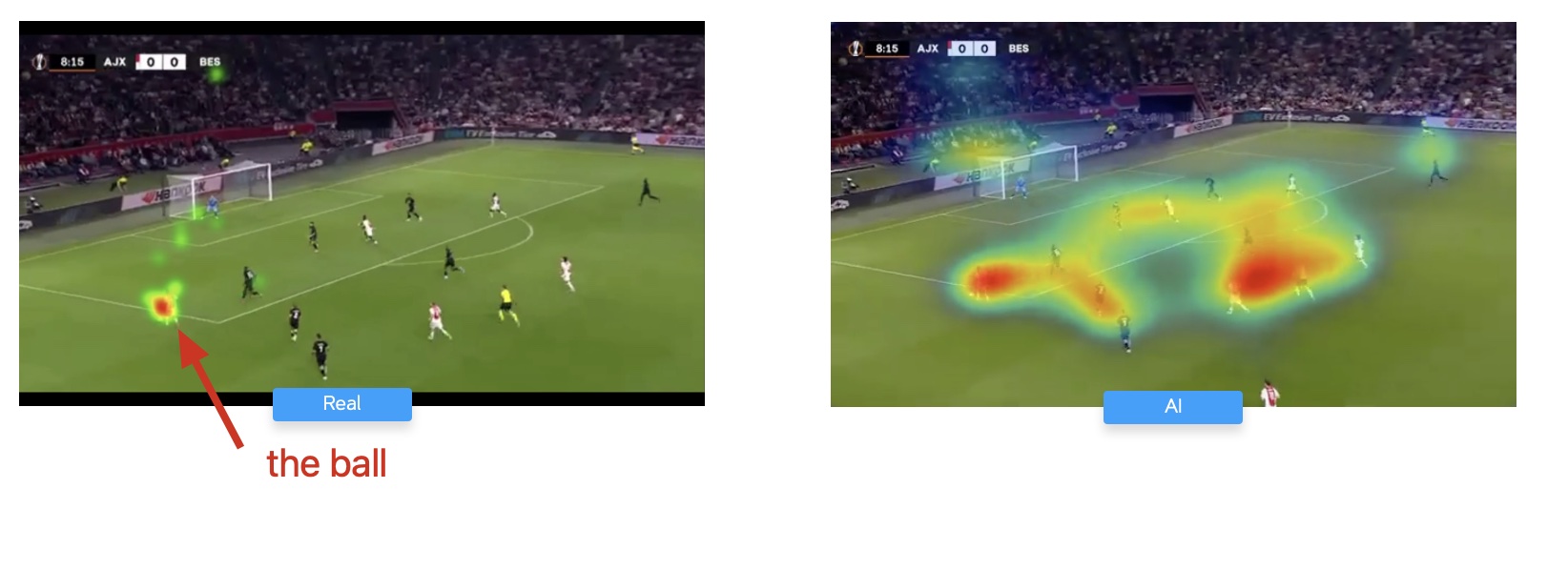
Completely the opposite of reality. And that is actually the perfect example of where AI misses the mark.
Top-Down and Bottom-Up Attention Explained
To understand why this happens, I need to walkt you through two forms of attention that we as humans always have; top-down and bottom-up attention.
Top-down attention is driven by context. Imagine you are in a shopping street and you are hungry. Then restaurants automatically stand out. Your brain sets the context ("I am hungry, I want to eat") and filters the world accordingly. Are you in that same shopping street but looking for jeans? Then suddenly the clothing stores stand out. Exactly the same location, completely different attention.
That is top-down - guided by what you want, what you know, what you experience.
Bottom-up attention comes more naturally. If you are walking through the woods and a bush moves, that automatically catches your eye. Bright colours attract your attention. Movement draws your attention. These are things that are evolutionarily ingrained in us. You don't have to think about it; it just happens.
And here lies the crux: AI is very good at predicting bottom-up attention, but very poor at top-down attention. The model knows that people look at faces (bottom-up, we have that naturally), but it doesn't know that within the context of football, you are looking at the ball. That context is simply not there.
Now, you might be thinking: “You can train a model on that football, right?” And you are certainly right about that. But the football in this example represents a ‘brand’, and while a football remains the same in ‘construct’ (white ball, black spots), the context of a brand in the brain continuously changes.
Why AI Misses the Context (and You Don’t)
That context - that is precisely what marketing is all about. How does your brand live in the consumer's brain? What brand assets have you built up? How many ads has someone seen from you? What are their previous experiences with your product?
Take Whiskas as an example. They have made fantastic use of brand assets. That typical Whiskas cat appears in every ad and on every product.

The result? If you, as a consumer, walk through the cat food aisle and you always buy Whiskas, that brand automatically stands out. Not because it has the brightest colour, but because it is anchored in your brain. That context is loaded.

An AI model does not know that. That model cannot know how many ads you have seen, how strongly that brand lives with you (in your brain), or whether you even buy cat food. It simply misses that meaningful context that you as a marketer have built up over the years.
The Examples: From Whiskas to Cracotte
We tested this with shelf photos. On the left, the real eye-tracking data - where people actually look. On the right, what the AI model predicts. And what do you see? The model says: you look at the most contrasting packaging. Logical from a bottom-up attention perspective - bright colours stand out.
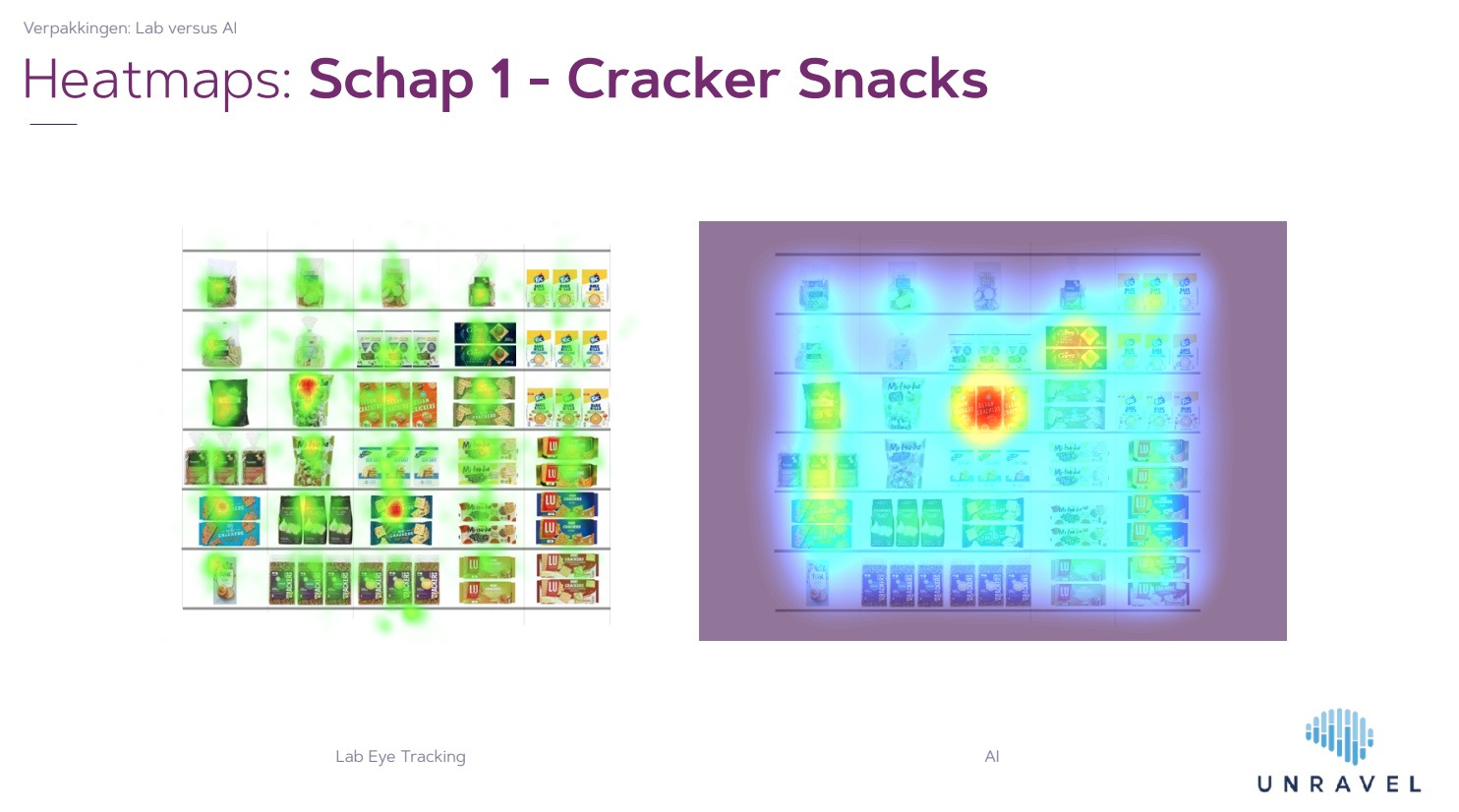
But look at where people really look when they want to buy something. There is a big difference. They look at the brands they know, at products they recognise, at things that fit what they are looking for.
The same is seen with packaging. Interestingly, AI performs slightly better there. Why? Because packaging on a white background is somewhat more bottom-up driven. What quickly attracts attention? In that context - without shelf environment, without other products - AI is somewhat closer to the truth. But as soon as you add context, it goes wrong.
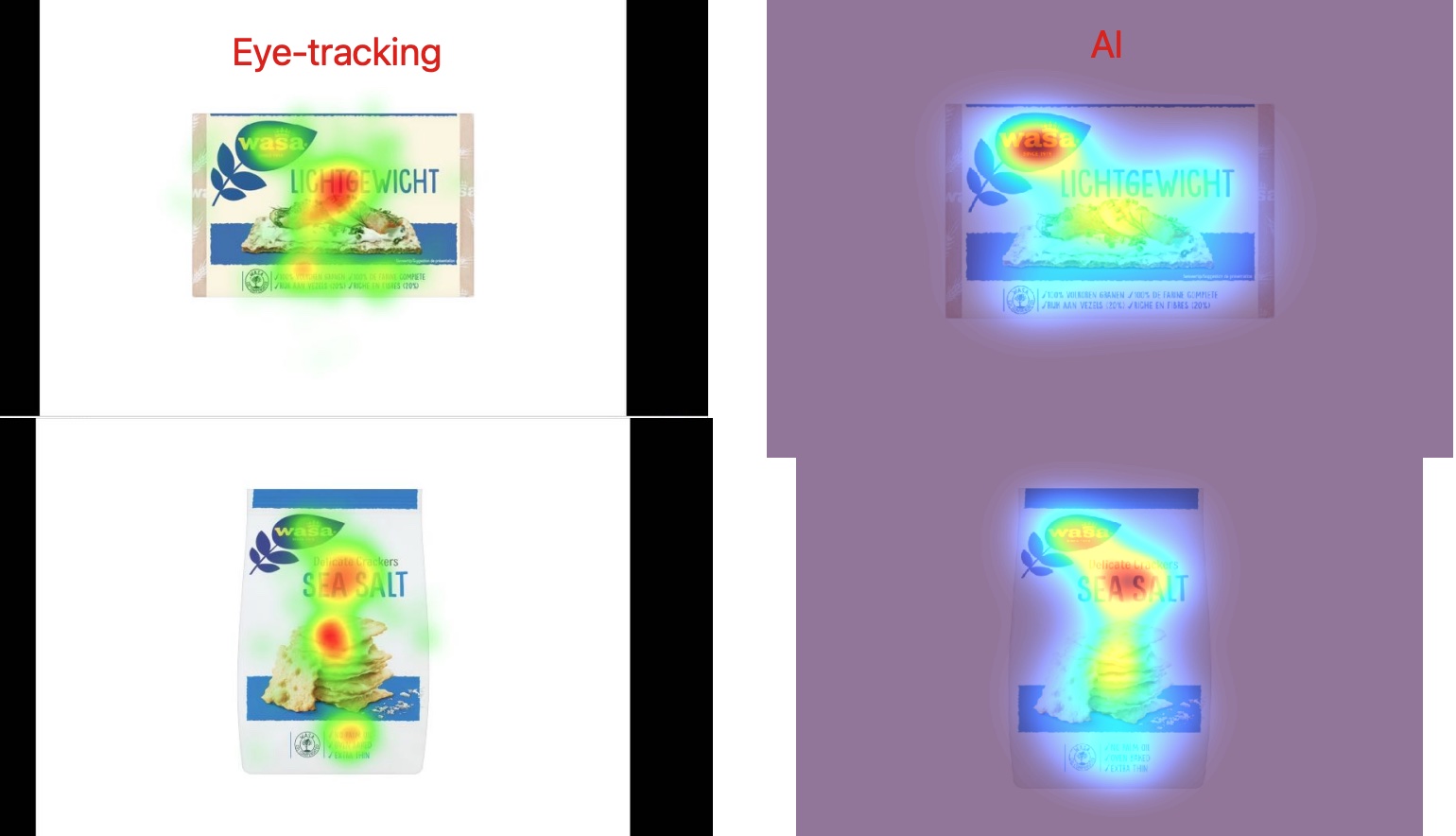
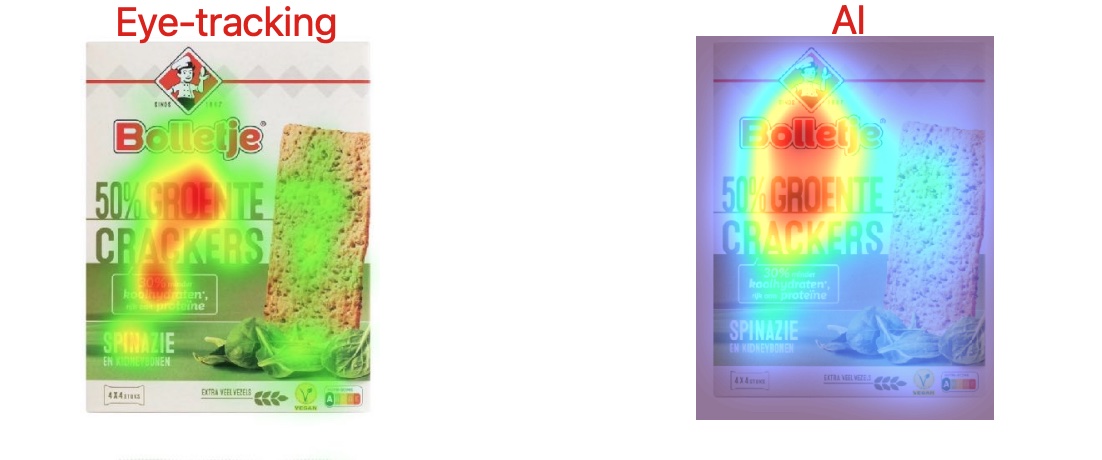
Look at the example of Bolletje. In the real eye-tracking, you see that people look at the window where you can see the product behind it. Consumers want to see the actual product - we know that. But the AI model? It does not predict that at all, because that window has no contrast or striking colour. From a bottom-up attention perspective, it does not stand out, but from the consumer's goal ("I want to see what I am buying"), it has a lot of attention value.
Or take an ad where a hand moves towards a pack. Real people look at that moving hand - logically, movement attracts attention and tells a story. The AI model? It says that no one looks at that hand and predicts attention for all sorts of other elements. Again, context is missing.
Predictive eye-tracking models score an average of 60 to 70 percent accuracy. That sounds quite high, you might say. But it is precisely in that last 30 to 40 percent where the context that is so important lies. That is the difference between a generic model and real insights into how your brand works.
What we also see is that AI often overrepresents logos. The model thinks: people must be looking at logos. But when we look at real eye-tracking, that is much less the case than you would think. So you might conclude that your logo scores well, while in reality, no one is looking at it.
In practice, this means the following: if you want to place two ads side by side and quickly check if attention is going where you want it to go? Then you can certainly use predictive AI. But if you want to truly evaluate one campaign and understand if it strikes the emotional chord? Then you miss crucial information if you rely solely on AI.
Want to Know How This Affects Your Brand?
This was, of course, just a small part of the story. We have talked about the fundamental weakness of AI when it comes to context - that top-down form of attention that is so crucial for your brand strategy.
But there is so much more. What about AI in content creation? Where are the limits of generative models? And most importantly: how can you smartly use AI in your marketing without losing the essence of neuromarketing?
All those answers can be found in the full webinar. We dive deeper into all the examples, show more eye-tracking data, and give you concrete tools to use predictive AI where it works - and to avoid it where it fails. Plus: you will get access to all the slides and key insights as a handy PDF download.
Curious? Sign up here to watch the recording →
Because one thing is certain: AI will not replace neuromarketing. But if you understand where the strength and weakness lie, you can use them smartly alongside each other. And that story you don't want to miss 😉


