


 EN
EN  NL
NL 
Every video contains an emotional peak. The moment when neurotransmitters in the brain fire wildly and excitement reaches its peak.
But with your online videos, you have one major challenge. What if this peak is halfway through your video, but the user only gives you 3 seconds to decide whether to keep watching?
The algorithm is optimised for those first few seconds, and the main data you see from your video shows when people drop off.
A missed opportunity, because as you will soon read, we saw that 5 videos we optimised based on brain data perform between 11% and 153% better 😱.
What is the right way to optimise videos? What results did we see in those 5 pilot studies (including one with Domino's), and which neuro tip 🧠 can you apply immediately for more impact? Read on!
Look, it would have been nice if the above was also the reason for the pilots we conducted in recent months.
But the reality is that I was simply amazed that we (at Unravel Research) test TV commercials so extensively (neuro), but that this - for now - seems to happen less with online videos.
That's a shame. Not only is a lot of money wasted on videos that are wrongly rejected, but we also miss the impact of branding on a brain level.
To find those raw gems (the highlights) in a video, you naturally have to show it in its entirety to a user. Then you need to measure whether the video manages to strike the emotional chord (and that can only be done on an unconscious level, in the brain). Asking questions is of course pointless, consumers don't do what they say and don't say what they do 😉.
Neuromarketing Research on Online Videos
With high-quality EEG, combined with eye tracking, you can measure this perfectly. Not only because of the speed (256 measurements per second 😱), but also because you can see one-on-one where people are looking, and what emotion they feel.
The key question is, of course, whether these insights from the brain also translate into actual ROI.
Finally, I can share the results of these studies with you!
Five brands (Domino's, Oxfam Novib, Sparkling Jewels, Amsterdam Vintage Jewels, and UNHCR) put it to the test.
For each brand, we were allowed to include an online video in our weekly multi-client study. 20 participants watched the video in our living room lab, while we tracked their reactions with EEG and eye tracking.
With this setup, you get a precise map of how the video manages to strike the right chord millisecond by millisecond (or fails to do so).
Take a look at the output below from one of the videos. The orange graph runs from left to right (in this case with a 17-second video).
At point 1 (after about 2 seconds), you immediately see a significant dip in the brain. That's not a good sign, because unconsciously our brains want to distance themselves here. The result? Users scroll on.
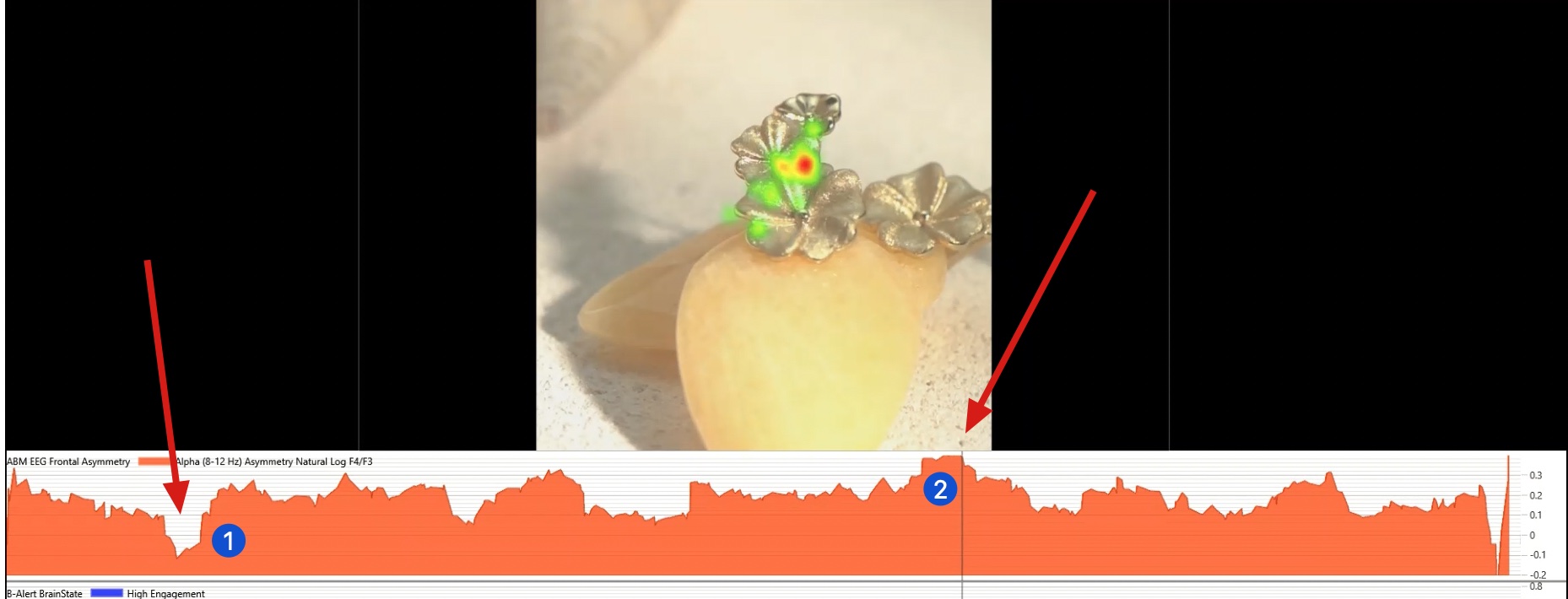
But wait, the gem of this video is almost halfway through (here at point 2). An emotional peak is reached.
Of course, this is a shame. The peak of the video is so far into the video that almost no one will see it. In this case, it also happens that extra people will have dropped off because there is a significant repelling clip at the beginning of the video.
The advice for this video was, among other things, to cut the scene with the dip and bring the highlights (significantly) forward.
The result for Sparkling Jewels? A 41.7% higher click-through rate! Bizarre, if you ask me.
Since I could hardly believe it, we decided to put another 4 videos to the neuro test.
I expected that 42% increase to be an 'outlier'. But, the results proved otherwise.
In summary:
Domino's: ✅ +11%
UNHCR: -26%
Oxfam Novib: ✅+69%
Amsterdam Vintage Jewels: ✅ +153%
Sparkling Jewels: ✅ +41%
In the interest of full transparency, I should also mention that the results for UNHCR were disappointing (as you can see; -26%). The only explanation I have is that this video was also very much focused on the 'sad story', which should ensure that people donate more. Perhaps in such a case, it is not wise to optimise for an emotional peak (because probably the whole video is more of an emotional low point).
On the other hand, there is the outlier of Amsterdam Vintage Jewels, with a 153% higher CTR. Bizarre, if you ask me 😇.
That's why I would strongly advocate that mapping those emotional peaks in your video is super valuable!
The Neuro Tip for Even More Effect
Here's one tip that seems to apply to both advertising and online video.
It is - also with online videos - dangerous to zoom out quickly. We see that the brain often mentally recoils. In other words, when you zoom out, you distance yourself from an object. And in the brain, this directly translates to emotional distancing.
That's a shame. Time and again, we see in our brain data (from 1000+ videos and counting) that zooming out causes a dip in emotion.
Try to avoid this as much as possible! Instead, zooming in works very well. Here too, the same mental recoil applies. If you like something, you seek proximity. The video equivalent of this is zooming in.
Test Your Online Video?
As you can see, testing your videos can cause a significant increase in ROI. Testing online videos can be easily done through our weekly neuromarketing multi-client studies. Read more about this testing method here.
You can of course also send me an email (), and we can discuss it further 😉


