Sooner or later, every product must face it: it gets a new look.
A packaging redesign is an especially exciting moment for marketers. Although the fresh new design is hoped to spark attention, relevance, and marketability of the product, history has shown more than once that it can go disastrously wrong.
Anyone involved in retail shelf arrangement is familiar with them: the so-called Customer Decision Trees. There are also similar concepts under the names Shopper Decision Tree and Consumer Decision Tree. In short, decision trees are popular in retail and have traditionally been the basis for shelf arrangement.
The decision tree models share the idea that they view the decision-making process as a step-by-step hierarchical process. First, you decide whether you want porridge, cornflakes, or crackers for breakfast (porridge!). Then you choose the grain type (oats!) and finally the brand (Quaker!). Sounds logical – until you investigate how customers actually make choices in the store.
Market Research & FMCG: The Right Tools for the Right Question
Succeeding as an FMCGbrand is becoming increasingly difficult. The growing competition makes securing a successful spot on the shelf harder, changing consumer needs demand flexibility, and media fragmentation makes it increasingly difficult to reach that one shopper.
A striking and attractive packaging, a good price, a positive brand image, and a solid set of brand assets are the key factors for success. And since 80% of products don't even make it to the end of the first year, it's crucial to have these things in order.
5 Surprising Examples of When People Don't Say What They Do and Do What They Say
“People don’t do what they say, and don’t say what they do.”
A quote you often hear at our office. And while this might sound as if we don't trust fellow humans at Unravel, that’s fortunately not the reason we repeat it so often. But why then?
We repeat this statement regularly because it perfectly explains why neuromarketing is so effective and gaining more attention. Namely: we humans are incredibly irrational.
The Sense and Nonsense of Brand Research – How to Conduct Good Brand Research
From greater brand awareness to brand building and from enhancing a brand image to establishing a new brand; for most marketing department targets, the brand is central. This is not surprising. The brand is often a major factor in the decision-making process. Even if the shopper is not aware of it.
This brings us to an immediate problem. If shoppers are unaware of a brand's role in their decision-making, how can we as marketers uncover it? In this blog, we will discuss the sense and nonsense of brand research.
How Advertisers Cleverly Use the Biases in Your Brain
Consumers love them: creative marketing campaigns. Think of Centraal Beheer's "Just call Apeldoorn", ORHA's "The purple crocodile", or Calvé's "Pietertje". And it's not just creative commercials that are well-received. Marketing expressions such as billboards, advertisements, or flyers are often enjoyed and shared when communicated creatively.
But how do companies create creative advertisements? What psychological principles are used to give your advertisement a creative twist and make people think? In this blog, we provide various examples of creative marketing communication expressions and the psychological principles underlying them.
This blog first appeared on Frankwatching (with 16,200 views & counting).
Have you ever considered the price per kilo of Nespresso's ground coffee beans? You pay a hefty 80 euros per kilo. Nespresso has managed to quintuple the willingness to pay. On average, coffee costs around 16 euros per kilo. How has Nespresso managed to charge five times the price for a kilo of coffee? What clever marketing techniques underpin this? And how can (e-commerce) brands cleverly emulate this 😉?
From Neuro-data to ROI: Maximizing Impact with Your Online Videos
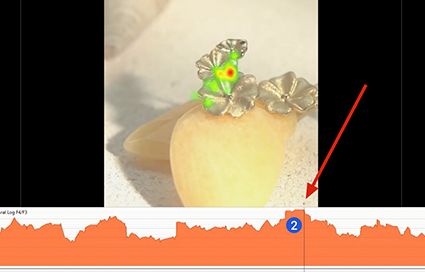
Every video contains an emotional peak. The moment when neurotransmitters in the brain fire wildly and excitement reaches its peak.
But with your online videos, you have one major challenge. What if this peak is halfway through your video, but the user only gives you 3 seconds to decide whether to keep watching?
The algorithm is optimised for those first few seconds, and the main data you see from your video shows when people drop off.
A missed opportunity, because as you will soon read, we saw that 5 videos we optimised based on brain data perform between 11% and 153% better 😱.
What is the right way to optimise videos? What results did we see in those 5 pilot studies (including one with Domino's), and which neuro tip 🧠 can you apply immediately for more impact? Read on!


 EN
EN  NL
NL